1558–1603
Elizabeth I & the Spanish Armada
Elizabeth I ruled England from 1558 to 1603, a time of explorers, theater and Shakespeare. In 1588 King Philip II of Spain sent a huge fleet, the Armada, to invade England, but smaller English ships and fierce storms scattered it. The victory made England a sea power.
Why artists painted it
Elizabeth's portraits were carefully designed to make her look powerful and almost magical. The famous Armada Portrait uses symbols and clothes to say: England rules the waves.
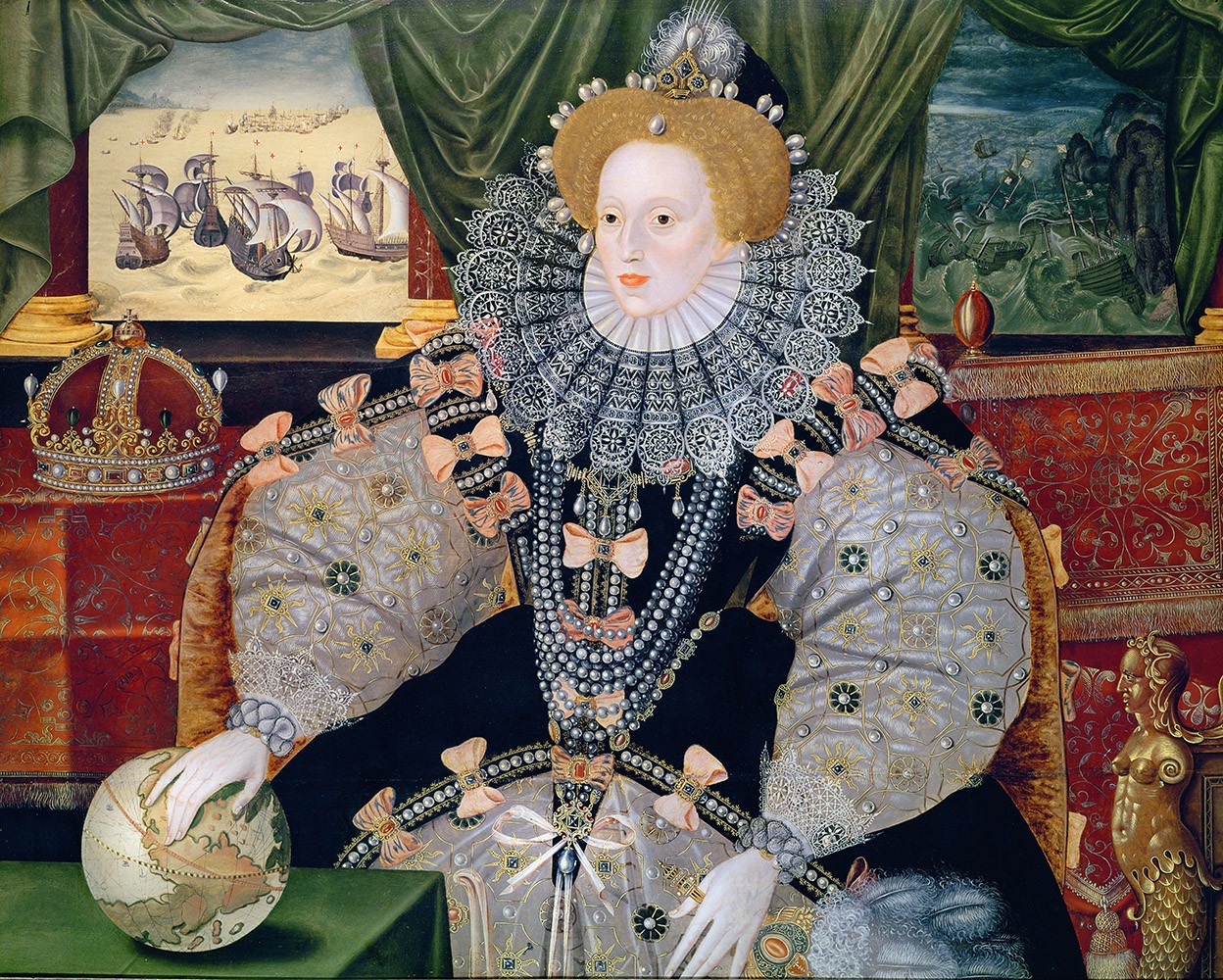 The Armada Portrait of Elizabeth I · English School (formerly attributed to George Gower), 1588
The Armada Portrait of Elizabeth I
English School (formerly attributed to George Gower) · 1588
👁️ Painted at the time
Queen Elizabeth I rests her hand on a globe, a symbol that she ruled the seas, while behind her are scenes of the Spanish Armada's defeat in 1588.
 The Defeat of the Spanish Armada
Philip James de Loutherbourg · 1796
🕰️ Painted about 190 years later
English fireships drift into the Spanish fleet at night in 1588 and the great Armada scatters in a blaze of flames.
 English Ships and the Spanish Armada, August 1588
English School · 1590
👁️ Painted at the time
A crowd of English and Spanish ships sail in the crescent formation of the Spanish Armada in this painting made not long after the battle of 1588.
 The Rainbow Portrait of Elizabeth I
English School (attributed to Marcus Gheeraerts the Younger) · 1602
👁️ Painted at the time
Elizabeth I, about 70 years old, holds a rainbow and wears a cloak covered in eyes and ears, a symbol of how much she saw.
 Elizabeth I
Marcus Gheeraerts the Younger · 1595
👁️ Painted at the time
Elizabeth I in a huge white ruff and jeweled gown, painted around 1595 by Marcus Gheeraerts the Younger.
 The Procession Portrait of Elizabeth I
Robert Peake the Elder (attributed) · 1601
👁️ Painted at the time
Elizabeth I is carried in a grand procession by her courtiers and noblemen, like the center of a parade.
 Philip II of Spain
Titian · 1551
👁️ Painted at the time
Philip II, King of Spain, as a young prince in glittering armor and white hose.
 Mary I of England
Antonis Mor · 1554
👁️ Painted at the time
Mary I, queen of England from 1553 to 1558, tried to bring England back to the Catholic Church and was nicknamed 'Bloody Mary' by her enemies.
 Mary, Queen of Scots
Unknown artist · 1560
👁️ Painted at the time
Mary, Queen of Scots, was Elizabeth I's cousin and rival, held prisoner in England for 19 years before she was beheaded in 1587.
 Sir Francis Drake
Marcus Gheeraerts the Younger · 1591
👁️ Painted at the time
Francis Drake rests his hand on a globe in a portrait celebrating his voyage around the world from 1577 to 1580, the first by an English captain.
 Sir Francis Walsingham
John de Critz · 1589
👁️ Painted at the time
Sir Francis Walsingham, Elizabeth I's spymaster, uncovered plots against the queen, including the one that led to the downfall of Mary, Queen of Scots.
 The Death of Queen Elizabeth I
Paul Delaroche · 1828
🕰️ Painted about 220 years later
The old queen sits on cushions on the floor of her room, refusing to go to bed, while her courtiers watch anxiously.
 Mary, Queen of Scots: The Farewell to France
Robert Herdman · 1867
🕰️ Painted about 260 years later
Eighteen-year-old Mary, Queen of Scots, stands on a ship leaving the shores of France in 1561, where she grew up, to return to Scotland.