1517–1648
The Protestant Reformation
In 1517 a German monk named Martin Luther challenged the Church by posting his 95 Theses. With the help of the printing press, his ideas spread fast and Europe split into Catholic and Protestant lands. The Reformation changed religion, politics, education and even who could read the Bible.
Why artists painted it
Protestant painters like Lucas Cranach made Luther's portrait famous in his own lifetime, and later artists painted dramatic scenes such as Luther standing alone before the Emperor at Worms.
 Luther at the Diet of Worms · Anton von Werner, 1877
 Luther at the Diet of Worms
Anton von Werner · 1877
🕰️ Painted about 230 years later
In 1521 Martin Luther stands in front of the Emperor Charles V in Worms and refuses to take back his writings, saying 'Here I stand.' Anton von Werner painted this scene in 1877 as a founding moment of the Reformation.
 Portrait of Martin Luther
Lucas Cranach the Elder · 1528
👁️ Painted at the time
Martin Luther, the monk who challenged the Church, in a portrait painted in 1528 by his friend Lucas Cranach the Elder.
 Portraits of Martin Luther and Philipp Melanchthon
Lucas Cranach the Elder · 1543
👁️ Painted at the time
Martin Luther and his friend and fellow reformer Philipp Melanchthon, shown side by side in two matching panels painted by Lucas Cranach the Elder in 1543.
 Luther Posting the 95 Theses
Ferdinand Pauwels (attributed) · 1872
🕰️ Painted about 220 years later
According to tradition, on October 31, 1517, Martin Luther nailed his 95 Theses, complaints against the Church's sale of pardons, to the church door in Wittenberg, which launched the Reformation.
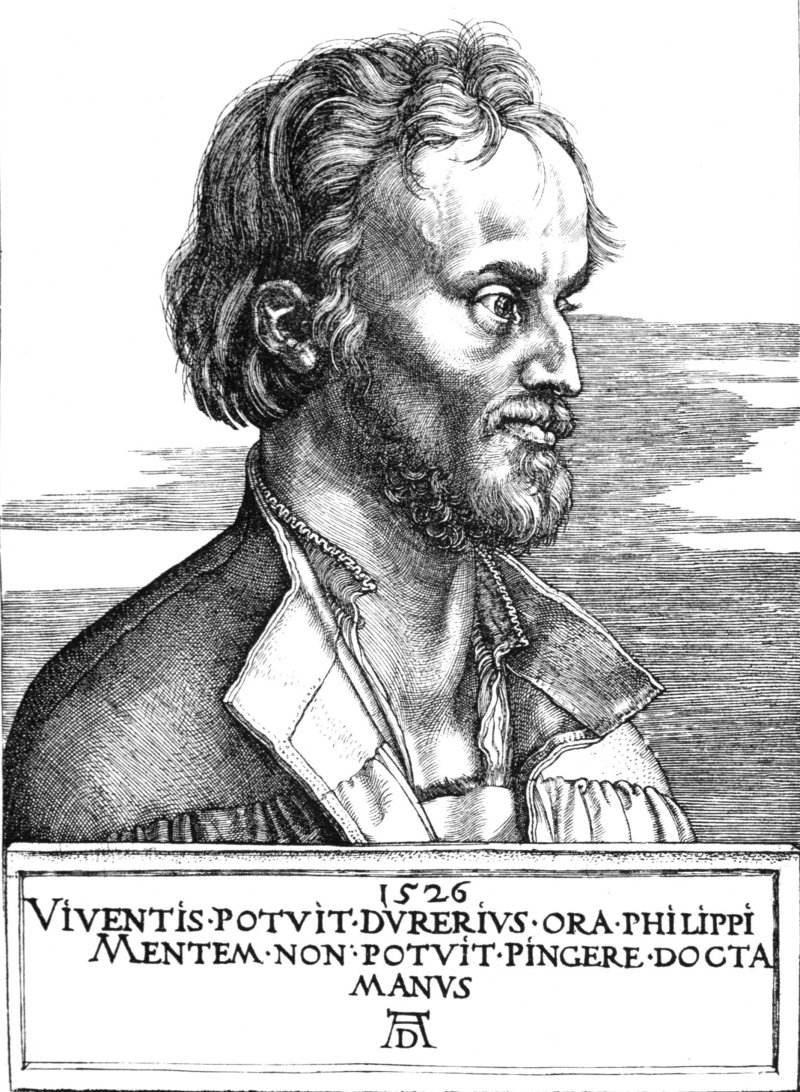 Philip Melanchthon
Albrecht Dürer · 1526
👁️ Painted at the time
Philipp Melanchthon, the teacher and thinker who became Luther's closest partner in the Reformation, in an engraving by Albrecht Dürer from 1526.
 Portrait of Erasmus of Rotterdam
Hans Holbein the Younger · 1523
👁️ Painted at the time
Erasmus, the Dutch scholar who wrote with wit about the Church's faults, sits writing in this calm portrait by Hans Holbein the Younger of 1523.
 Portrait of Henry VIII
Hans Holbein the Younger · 1537
👁️ Painted at the time
Henry VIII, in a puffed gold and jeweled jacket, stands with his hands on his hips in this Holbein portrait of 1537.
 Thomas Cranmer
Gerlach Flicke · 1545
👁️ Painted at the time
Thomas Cranmer, the Archbishop of Canterbury who helped Henry VIII break with Rome and wrote the English Book of Common Prayer, was burned at the stake in 1556 under Queen Mary.
 Thomas Cromwell
Hans Holbein the Younger · 1533
👁️ Painted at the time
Thomas Cromwell, Henry VIII's chief minister, carried out the king's break with Rome and closed England's monasteries, but he fell from power and was executed in 1540.
 The Field of the Cloth of Gold
British School · 1545
👁️ Painted at the time
In 1520 King Henry VIII of England and King Francis I of France met near Calais in a huge display of tents, banquets and tournaments, each trying to look richer than the other.
 The Council of Trent
Pasquale Cati · 1588
👁️ Painted at the time
Bishops fill a great hall at the Council of Trent, held between 1545 and 1563 to answer the Protestant Reformation and reform the Catholic Church.
 Henry VIII's First Interview with Anne Boleyn
Daniel Maclise · 1836
🕰️ Painted about 190 years later
King Henry VIII meets Anne Boleyn in a palace hall, the beginning of the romance that led him to break with the Catholic Church.
 The Great Matter
Emanuel Leutze · 1846
🕰️ Painted about 200 years later
Catherine of Aragon kneels before her husband Henry VIII at a church court in 1529, begging him not to end their marriage.
 Portrait of Pope Paul III
Titian · 1543
👁️ Painted at the time
Pope Paul III, the pope who called the Council of Trent and approved the new Jesuit order, in a portrait painted by Titian in 1543.