1095–1291
The Crusades
Beginning in 1095, European armies marched east to capture Jerusalem and the Holy Land. Over about 200 years there were many crusades, with famous leaders like Richard the Lionheart and Saladin. They changed trade, travel and ideas between Europe and the Middle East, but caused great suffering too.
Why artists painted it
Romantic painters of the 1800s loved the Crusades as tales of knights and faraway adventures, often prettier than the real history. Looking closely, you can ask: whose side is the painter showing?
 Entry of the Crusaders in Constantinople · Eugène Delacroix, 1840
 Entry of the Crusaders in Constantinople
Eugène Delacroix · 1840
🕰️ Painted about 550 years later
Crusaders ride into Constantinople in 1204, in a scene that shows how the crusades could turn on fellow Christians.
 The Children's Crusade
Gustave Doré · 1877
🕰️ Painted about 590 years later
In 1212 thousands of European children, many in poor families, set off on a march to the Holy Land, and most never got there.
 Bohemond Alone Mounts the Rampart of Antioch
Gustave Doré · 1877
🕰️ Painted about 590 years later
The Norman leader Bohemond climbs the walls of Antioch in 1098 in one of the crusaders' most daring moments.
 Dandolo Preaching the Crusade
Gustave Doré · 1877
🕰️ Painted about 590 years later
The aged and blind Doge of Venice, Enrico Dandolo, speaks in front of the cathedral to stir up the Fourth Crusade.
 Baldwin of Boulogne Entering Edessa in February 1098
Joseph-Nicolas Robert-Fleury · 1840
🕰️ Painted about 550 years later
Baldwin of Boulogne, a leader of the First Crusade, is welcomed into the city of Edessa in 1098, where he became its ruler and founded the first Crusader state.
 Richard the Lionheart at the Battle of Acre
Philip James de Loutherbourg · 1807
🕰️ Painted about 520 years later
Richard the Lionheart of England fights in the siege of Acre during the Third Crusade, in 1191.
 The Conquest of Constantinople by the Crusaders in 1204
Loyset Liédet · 1470
🕰️ Painted about 180 years later
In 1204 crusaders on the Fourth Crusade attacked the Christian city of Constantinople from their ships instead of going to the Holy Land.
 The Council of Clermont
Jean Colombe · 1474
🕰️ Painted about 180 years later
In 1095 Pope Urban II gives a famous speech at Clermont that started the First Crusade, and the crowd shouts 'God wills it!' This illustration comes from a French manuscript made around 1474.
 Saladin and Guy of Lusignan
Matthew Paris · 1250
👁️ Painted at the time
Saladin, the great Muslim leader who recaptured Jerusalem in 1187, meets Guy of Lusignan, the king of Jerusalem he had defeated at Hattin.
 The Capture of Constantinople
Jacopo Tintoretto · 1585
🕰️ Painted about 290 years later
Jacopo Tintoretto paints the Venetians and crusaders capturing Constantinople in 1204 as a dark swirl of fighting.
 Louis IX, called Saint Louis
Émile Signol · 1844
🕰️ Painted about 550 years later
King Louis IX of France, called Saint Louis, rides on a rearing horse.
 Emperor Frederick II Meets Sultan al-Kamil
Giovanni Villani (Nuova Cronica) · 1350
🕰️ Painted 59 years later
In 1229 Emperor Frederick II made a treaty with Sultan al-Kamil of Egypt, which gave Jerusalem back to the Christians without a battle.
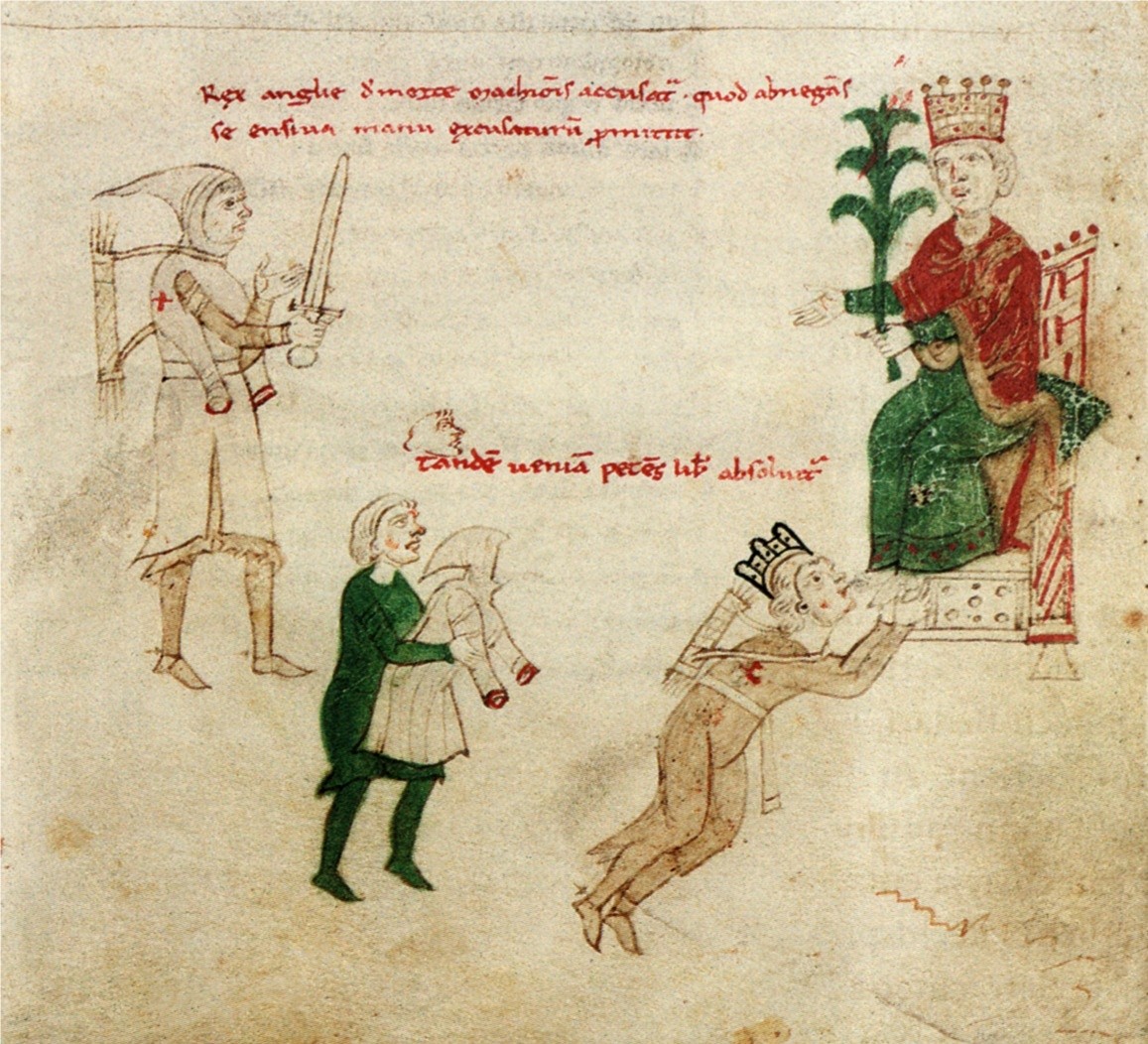 Henry VI Pardons Richard the Lionheart
Peter of Eboli · 1196
👁️ Painted at the time
After the Third Crusade, Richard the Lionheart was captured on his way home and held for ransom by the Holy Roman Emperor Henry VI, who finally pardoned him.