1642–1688
The English Civil War
King Charles I and Parliament went to war in 1642 over who should rule England. Oliver Cromwell's army won, and in 1649 the king was put on trial and executed. England became a republic for a few years, then brought back a king in 1660; in 1688 the Glorious Revolution settled that Parliament has the final say.
Why artists painted it
Painters loved the contrast between royal elegance and the grim fight that ended it. The scenes of Charles I's last days and Cromwell's soldiers are some of the most emotional pictures in British art.
 The Eve of the Battle of Edge Hill, 1642 · Charles Landseer, 1845
 The Eve of the Battle of Edge Hill, 1642
Charles Landseer · 1845
🕰️ Painted about 160 years later
Cavaliers and soldiers share a quiet meal and some rest before the first big battle of the English Civil War in 1642.
 Cromwell at the Battle of Naseby, 1645
Charles Landseer · 1851
🕰️ Painted about 160 years later
Oliver Cromwell leads the cavalry charge at Naseby in 1645, the battle where Parliament's New Model Army won the English Civil War.
 Oliver Cromwell
Robert Walker · 1649
👁️ Painted at the time
Oliver Cromwell, the commander of the Parliament's army in the English Civil War, stands in armor with a young page beside him.
 Equestrian Portrait of Charles I
Anthony van Dyck · 1637
👁️ Painted at the time
King Charles I rides a gray horse in a grand portrait by Anthony van Dyck of about 1637.
 Charles I in Three Positions
Anthony van Dyck · 1635
👁️ Painted at the time
Anthony van Dyck painted the face of King Charles I from three sides in 1635 so that the sculptor Bernini in Rome could carve a bust of the king from the picture.
 The Five Eldest Children of Charles I
Anthony van Dyck · 1637
👁️ Painted at the time
The five eldest children of Charles I, including the future kings Charles II and James II, stand with a huge dog in one of the sweetest royal portraits.
 And When Did You Last See Your Father?
William Frederick Yeames · 1878
🕰️ Painted about 190 years later
A small boy, the son of a Royalist, is questioned by Parliament's officers about where his father is hiding.
 The Proscribed Royalist, 1651
John Everett Millais · 1853
🕰️ Painted about 160 years later
A hiding Royalist soldier in a hollow tree is brought food and secret messages by the girl he loves, who is on the other side of the war.
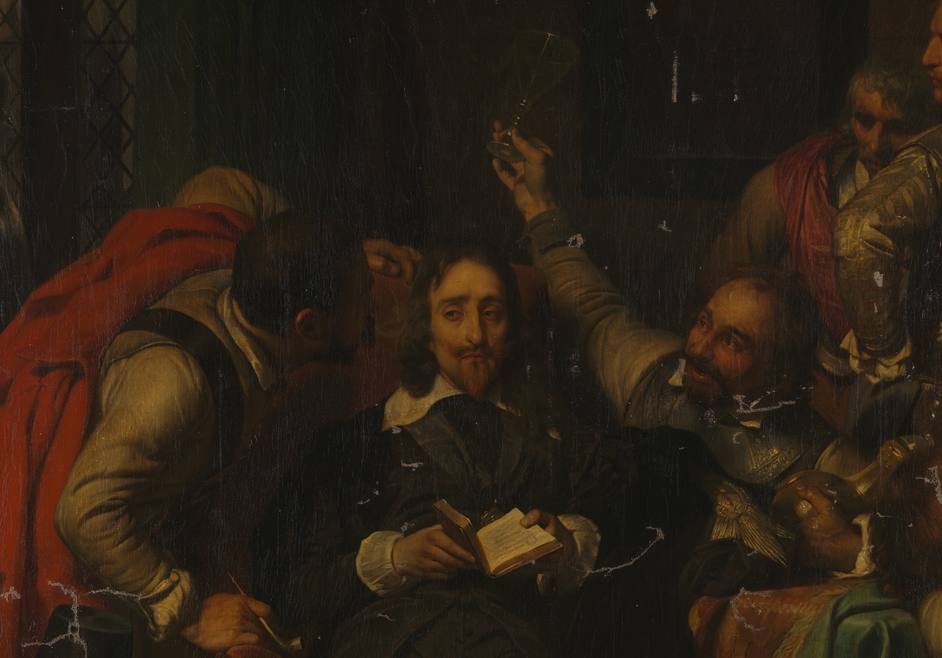 Charles I Insulted by Cromwell's Soldiers
Paul Delaroche · 1837
🕰️ Painted about 150 years later
King Charles I sits quietly while his Puritan guards mock him before his trial in 1649.
 The Execution of King Charles I
Unknown artist · 1649
👁️ Painted at the time
A crowd gathers outside the Banqueting House in London on January 30, 1649, where King Charles I was beheaded, the only time an English king was executed.
 King Charles II
John Michael Wright · 1665
👁️ Painted at the time
Charles II, who was brought back as king in 1660 after eleven years without a monarch, sits in elegant robes.
 The Battle of the Boyne
Jan van Huchtenburgh · 1690
👁️ Painted at the time
In July 1690 the Protestant King William III defeated the Catholic King James II at the Battle of the Boyne in Ireland, ending James's hope of getting back his throne.
 A Lost Cause: Flight of King James II
Andrew Carrick Gow · 1888
🕰️ Painted about 200 years later
King James II, who had lost his throne in the Glorious Revolution of 1688, waits on the shore for a boat to take him into exile in France.