1826 → today
Photography Through Time
Scroll down through two centuries. In each chapter you'll find what changed, who changed it, and a few of the photographs that show it.
-
🪞
1826–1850
The Magic Mirror
Before 1826, nobody had ever seen a photograph. Then inventors in France and England found a way to make sunlight draw a picture. The first one took about eight hours to expose. A few years later, mirror-bright daguerreotypes and paper calotypes let people see their own faces — and the world — held perfectly still for the very first time.
1826Nicéphore Niépce makes the oldest surviving photograph from his window in France. The exposure takes hours.1839Louis Daguerre announces the daguerreotype. The word “photography” is coined the same year.1839Robert Cornelius takes what's often called the first photographic selfie, in Philadelphia.1841William Henry Fox Talbot patents the calotype: a paper negative you can print again and again.1843Anna Atkins publishes the first book illustrated with photographs, using the cyanotype (blue) process.All 266 photographs from this chapter → View from the Window at Le Gras · 1826
 Boulevard du Temple · 1838
 Self-Portrait · 1839
 Newhaven Fishwife · 1845
 Earliest Known Photograph of a Living Animal · 1842
 Chouteau's Pond, St. Louis · 1851
 Frederick Douglass · 1847
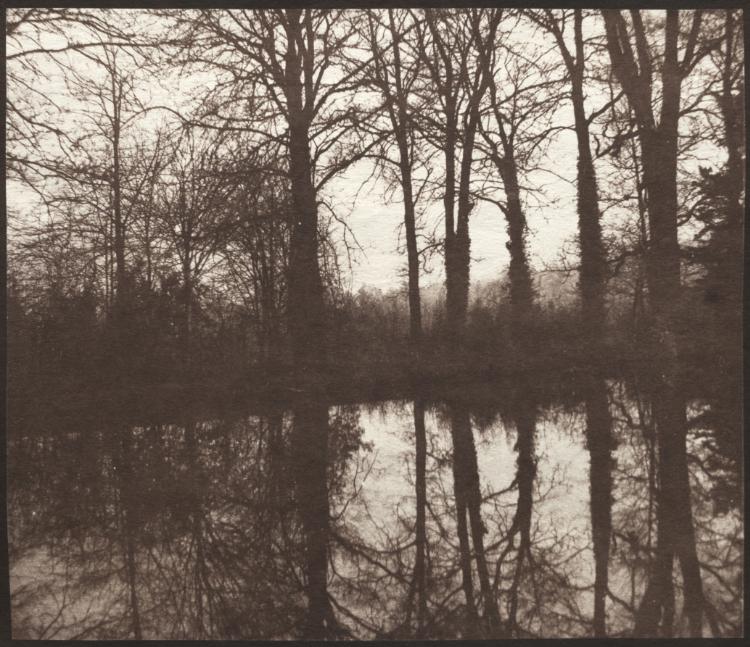 Winter Trees Reflected in a Pond · 1841
-
🏔️
1851–1879
Glass, Wars & Faraway Places
Photographers now coated glass plates with sticky chemicals, shot a picture, and developed it on the spot, often in a tent or a wagon. They hauled that darkroom to the Crimean War, the American Civil War, the Himalayas and Yosemite, and sent home pictures that made the big world feel real. Mathew Brady, Roger Fenton, Carleton Watkins, Julia Margaret Cameron and Eadweard Muybridge worked in this era.
1851Frederick Scott Archer's wet collodion process makes sharp glass negatives that can be copied.1855Roger Fenton photographs the Crimean War, one of the first wars to be photographed.1861The American Civil War begins; Mathew Brady's team and Alexander Gardner photograph it for the nation.1872Eadweard Muybridge starts photographing galloping horses to settle a famous bet.1878Muybridge's Horse in Motion shows that a galloping horse really does have all four hooves off the ground.All 520 photographs from this chapter → The Valley of the Shadow of Death · 1855
 A Harvest of Death, Gettysburg · 1863
 Abraham Lincoln at Cooper Union · 1860
 First View of the Yosemite Valley · 1865
 Brig on the Water · 1856
 Sojourner Truth · 1864
 Sir John Herschel · 1867
 The Horse in Motion · 1878
-
📦
1880–1909
Everyone Gets a Camera
Dry plates and then roll film meant you didn't have to be a chemist to take a photograph. In 1888 George Eastman's Kodak promised, "You press the button, we do the rest," and by 1900 a Brownie camera cost one dollar. Suddenly there were snapshots of families, city streets and fast-moving things, and reformers like Jacob Riis used photographs to show how others lived.
1880The first photograph is printed in a newspaper using the halftone process.1888George Eastman launches the Kodak camera: “You press the button, we do the rest.”1890Jacob Riis publishes How the Other Half Lives, using flash photographs of New York's poorest streets.1900The $1 Brownie camera puts photography into children's hands.1907The Lumière brothers sell Autochrome plates: the first practical color photographs.All 292 photographs from this chapter → The Steerage · 1907
 Addie Card, Age 12 · 1910
 Old Faithful · 1871
 The Terminal · 1893
 Bandits' Roost · 1888
 Sun Rays — Paula, Berlin · 1889
 The Wright Brothers' First Flight · 1903
 Nikola Tesla in His Laboratory · 1899
-
🎨
1910–1934
Photography Becomes Art
Were photographs art? Alfred Stieglitz and his friends said yes. Some made soft, painterly pictures; others went for razor-sharp skyscrapers and close-ups of everyday things. The Lumière brothers' Autochrome and the Russian photographer Sergey Prokudin-Gorsky gave the world its first real color photographs, and the small, fast Leica camera was about to change everything.
1914Oskar Barnack builds the first Leica prototype, the model for small 35mm cameras.All 254 photographs from this chapter → The Emir of Bukhara · 1911
 Isadora Duncan at the Parthenon · 1921
 Power House Mechanic · 1920
 Fountain by Marcel Duchamp · 1917
 Lunch Atop a Skyscraper · 1932
 The Endurance at Night · 1915
 Boulevard Haussmann · 1865
 Georgia O'Keeffe · 1918
-
📰
1935–1949
The Camera Tells the Truth
During the Great Depression, the US government hired photographers like Dorothea Lange and Walker Evans to record hard times. Then came the Second World War, and magazines such as Life brought news pictures into every home. Photographs began to change what people believed and what laws they supported. This chapter has a few difficult images, shown with care.
1935Kodak introduces Kodachrome, a color film with rich, lasting colors.1935The US government's Farm Security Administration begins photographing the Great Depression.1936Life magazine launches and puts photographs at the center of the news.1947Photographers including Robert Capa and Henri Cartier-Bresson found the Magnum agency.1948Edwin Land's Polaroid camera produces a finished photograph in about a minute.All 221 photographs from this chapter → Migrant Mother · 1936
 Raising the Flag on Iwo Jima · 1945
 Kissing the War Goodbye · 1945
 Into the Jaws of Death · 1944
 American Gothic, Washington, D.C. · 1942
 The Hindenburg Disaster · 1937
 Allie Mae Burroughs · 1936
 Farmer Walking in a Dust Storm · 1936
-
🌙
1950–1979
Color, Cities & the Moon
Color film got cheaper, television and glossy magazines hungered for pictures, and photographers walked city streets looking for surprising moments. Then astronauts carried cameras to the Moon. In 1968 the Apollo 8 crew took a picture of Earth rising over the lunar horizon, and people saw their whole planet as one small, fragile marble.
1968Apollo 8 astronauts photograph Earthrise over the Moon.1969Apollo 11 astronauts take pictures of each other on the Moon.1975Kodak engineer Steven Sasson builds the first digital camera. It weighs eight pounds and records black-and-white pictures to a cassette tape.All 103 photographs from this chapter → Earthrise · 1968
 Footprint on the Moon · 1969
 Buzz Aldrin Salutes the Flag · 1969
 The Blue Marble · 1972
 Jackie Robinson · 1954
 March on Washington · 1963
 Yuri Gagarin · 1961
 Self-Portrait on Geary Street · 1958
-
📱
1980–2999
The Digital Age
The first digital camera was built in 1975, and by the 2000s film was fading away. Today more photographs are taken every few minutes than were made in the entire nineteenth century. Space telescopes like Hubble and Webb use giant digital cameras to photograph galaxies billions of years old, and anyone with a phone can share a picture with the whole world in seconds.
1990Adobe Photoshop is released, and the Hubble Space Telescope is launched.2000The first camera phones go on sale in Japan.2007The iPhone arrives, and soon a good camera fits in every pocket.2022The James Webb Space Telescope releases its first images of faraway galaxies.All 410 photographs from this chapter → The Pillars of Creation, 2014 · 2014
 The Cosmic Cliffs · 2022
 The Hubble Ultra Deep Field · 2004
 Curiosity's First Selfie · 2012
 Earthset from Orion · 2026
 The Indian Ocean Tsunami · 2004
 The Green Comet · 2023
 Machu Picchu · 2009